
 Accounts
Last Updated: October 30, 2026
Quick Summary
The best carry-on luggage for frequent flyers is the Biaggi Glide Expandable Carry On at $119.99, a 5.95 lb polypropylene hardside bag that leaves more of your weight allowance for belongings on airlines that weigh cabin bags. Other picks include the Runway Hardside Hybrid at $199.99 and the foldable Zipsak Boost! Underseater at $99.99.
- A weekly flyer puts a carry-on through roughly 50 round trips and about 100 airport handlings a year.
- Hinomoto wheels on the Runway Hardside Hybrid are the most repairable component on the bag.
- The Zipsak Boost! folds to a pouch and expands a full 5 inches into a TSA-approved carry-on.
- The 22 x 14 x 9 in standard is not universal, and Southwest allows 24 x 16 x 10 in.
- International cabin weight limits cluster around 15 to 22 lb on carriers like Emirates and Ryanair.
Table of Contents
- What Frequent Flyers Actually Need From Carry-On Luggage
- The 5 Best Carry-On Luggage Options for Frequent Flyers at a Glance
- 1. Glide Expandable Carry On: Best Lightweight Carry-On Luggage Under 6 lbs
- 2. Runway Hardside Hybrid Carry On: Best Hard-Shell vs. Soft-Sided Compromise
- 3. Runway Hybrid Expandable Underseater: Best for Overhead Bin Stress
- 4. Zipsak Boost! Underseater: Best Foldable Carry-On Luggage for Small Apartments
- 5. Runway Hardside Hybrid Carry On + Zipcubes Bundle: Best for Organized Packers
- Carry-On Luggage Size Limits: What to Check Before You Buy
- Frequently Asked Questions
What Frequent Flyers Actually Need From Carry-On Luggage
The best carry-on luggage for frequent flyers solves three problems at once: it survives constant handling, stays within airline size limits, and never wastes a kilogram of your weight allowance. Biaggi builds foldable, space-saving bags for this kind of travel.
Most buying guides rank bags by looks. A weekly flyer drags a suitcase through security queues, lifts it into overhead bins, and folds it into a closet between trips. The bag has to hold up under all three.
Below, we break down five carry-on options and the airline limits that decide whether your bag boards or gets gate-checked.
The 5 Best Carry-On Luggage Options for Frequent Flyers at a Glance
Here is the short version. Every pick below is a Biaggi carry-on, chosen for a different travel style rather than ranked by price alone. Because frequent flyers care less about looks and more about what fails first, the table also flags the parts that wear out.
| Pick | Price | Best For | Key Strength | Wear Points to Watch | Ownership Notes |
|---|---|---|---|---|---|
| Glide Expandable Carry On | $119.99 | Light packers | 5.95 lbs polypropylene shell | Front-opening hinge, telescoping handle | Lightest option; lowest weight penalty on weighed carriers |
| Runway Hardside Hybrid Carry On | $199.99 | Hybrid fans | Polycarbonate shell, Hinomoto wheels | Wheel housings, zipper track | Hinomoto wheels are the most repairable component on the bag |
| Runway Hybrid Expandable Underseater | $164.99 | Bin-avoiders | Fits under the seat | Expansion zipper, drink port | Avoids gate-check fees entirely on most carriers |
| Zipsak Boost! Underseater | $99.99 | Small apartments | Folds to a pouch, expands 5" | Fold creases, wheel mounts | Lowest storage footprint; check fold seams after heavy use |
| Runway Carry On + Zipcubes Bundle | $219.99 | Organized packers | Matched packing cubes included | Same as Runway hybrid | Cubes extend bag life by reducing loose-item stress on zippers |
What 'durability' actually means for a frequent flyer
Most buying guides rate durability by how a bag feels in the store. A weekly flyer puts a carry-on through roughly 50 round trips a year, about 100 airport handlings, 100 overhead-bin lifts, and 100 curb-to-terminal rolls. The parts that fail first, in rough order of frequency, are:
- Wheels and wheel housings. Spinner wheels take the most abuse on cobblestones, escalator lips, and curb drops. Hinomoto wheels (used on the Runway Hardside Hybrid) are a known Japanese component brand and the part most worth checking for replaceability.
- Telescoping handles. The locking mechanism and the tube-to-housing joint are common failure points. A handle that wobbles when fully extended is a warning sign.
- Zippers and expansion tracks. Front-opening and expandable bags stress zippers more than clamshell designs. YKK zippers are the industry benchmark.
- Shell and corner guards. Polypropylene and polycarbonate resist cracking better than ABS, but corners still take the impact. Replaceable corner bumpers extend bag life significantly.
- Fabric and coating. Soft-sided bags fail at seams and coating first, and coatings degrade with UV and repeated cleaning.
The ownership-cost math frequent flyers should run
The sticker price is only the first number. Total ownership cost is purchase price plus repairs minus warranty coverage, divided by expected years of use. A few patterns hold:
- Warranty coverage varies widely. Some brands offer limited lifetime warranties covering shell and wheels; others cover manufacturing defects only for one to five years. Cosmetic wear and airline damage are almost always excluded.
- Airline damage is usually not a warranty claim. Most carriers will repair or reimburse for damage they cause, but the process takes time. Replaceable wheels let you fix it yourself in an afternoon.
- Replacement parts are the real value signal. Brands that sell wheels, handles, and interior liners as standalone parts are signaling the bag is meant to be repaired, not replaced.
How to test a bag before you commit
You cannot replicate years of travel in a store, but you can run a five-minute stress check:
- Roll the bag fully loaded across a rough surface, not just smooth tile. Listen for wheel wobble.
- Extend the handle fully and push down on it. Any flex at the joint is a future failure.
- Open and close every zipper ten times. A zipper that catches when new will fail when full.
For a wider look at how foldable designs compare with fixed shells, our foldable luggage range shows how a bag can compress for storage without losing structure in transit.

1. Glide Expandable Carry On: Best Lightweight Carry-On Luggage Under 6 lbs
The Glide is our lightest hardside carry-on. At 5.95 lbs, it leaves more of your weight allowance for belongings on airlines that weigh cabin bags.

2. Runway Hardside Hybrid Carry On: Best Hard-Shell vs. Soft-Sided Compromise
Soft-sided luggage flexes into tight bins but offers less protection. Hard-shell luggage protects better but gives you no give. The Runway Hardside Hybrid Carry On takes the middle path, pairing a German polycarbonate shell with the packability of a soft bag.
The Runway uses Japanese "silent-run" Hinomoto wheels.
Best for: flyers who want hard-shell protection with soft-side packing flexibility. Skip if: you want the absolute lowest weight.
Check the Runway Hardside Hybrid Carry On details

3. Runway Hybrid Expandable Underseater: Best for Overhead Bin Stress
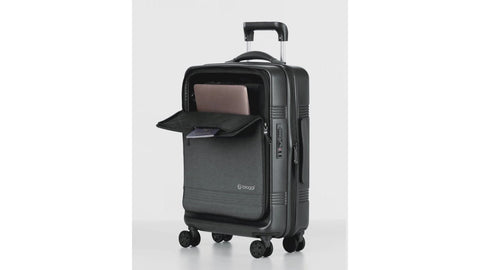
The Runway Hybrid Expandable Underseater is designed to fit under the seat in front of you, so you avoid relying on overhead bin space.
Premium materials and wheels keep it rolling smoothly, and easy front access means you can reach your laptop or charger without pulling the bag out.
Best for: short business trips where you want zero bin anxiety. Skip if: you need a week's worth of clothing in one bag.
View the Runway Hybrid Expandable Underseater

4. Zipsak Boost! Underseater: Best Foldable Carry-On Luggage for Small Apartments
If closet space is your real constraint, this is the bag to look at. The Zipsak Boost! starts as a small, easy-to-store pouch and opens into a four-wheeled carry-on that slides under the airplane seat.
An extra-deep packing cube is included, so clothes can go in the cube while the rest of the bag stays free for other items.
Best for: apartment dwellers and students who need storage to disappear between trips. Skip if: you prefer a rigid shell.
See the Zipsak Boost! Underseater
5. Runway Hardside Hybrid Carry On + Zipcubes Bundle: Best for Organized Packers
Packing efficiency comes down to interior organization, and this bundle handles it before you pack a single item. You get the Runway hybrid carry-on plus Zipcubes that fit inside it like a jigsaw puzzle: a 3-pack of carry-on-size cubes and a Mini Cubes Duo.
The bundle includes the Runway carry-on plus Zipcubes that fit inside it.
Best for: travelers who plan their packing and want a system, not just a bag. Skip if: you travel with loose items and no packing routine.
Explore the Runway Carry On + Zipcubes Bundle
Carry-On Luggage Size Limits: What to Check Before You Buy
Carry-on rules are where frequent flyers get burned. The bag that glides onto a domestic mainline jet can be gate-checked on a regional carrier or a strict international low-cost airline, and the difference is often a centimeter or a kilogram.
The three numbers that decide whether your bag boards
Every airline publishes three separate limits, and they are not interchangeable:
- Overhead carry-on dimensions: the maximum height × width × depth for a bag that goes in the bin. This is the number most luggage is designed around.
- Personal-item dimensions: the smaller bag that fits under the seat in front of you. Underseaters and foldable bags live or die by this number.
- Weight limit: the maximum packed weight for a cabin bag. Some airlines never weigh; others weigh at the gate on every flight.
A bag can pass the size test and fail the weight test, or pass both and still be rejected because it is a personal item being used as a carry-on. Check all three before you buy.
Airline-by-airline carry-on limits frequent flyers should know
| Airline | Overhead carry-on (approx.) | Personal item (approx.) | Weight limit |
|---|---|---|---|
| American Airlines | 22 × 14 × 9 in | 18 × 14 × 8 in | No published cabin weight limit |
| Delta Air Lines | 22 × 14 × 9 in | Fits under seat | No published cabin weight limit |
| United Airlines | 22 × 14 × 9 in | 17 × 10 × 9 in | No published cabin weight limit |
| Southwest Airlines | 24 × 16 × 10 in | 18.5 × 8.5 × 13.5 in | No published cabin weight limit |
| JetBlue | 22 × 14 × 9 in | 17 × 13 × 8 in | No published cabin weight limit |
| Alaska Airlines | 22 × 14 × 9 in | 15 × 11 × 6 in | No published cabin weight limit |
| Ryanair | 21.6 × 15.7 × 7.8 in (paid priority) | 15.7 × 9.8 × 7.8 in | 22 lb |
| easyJet | 22 × 17.7 × 9.8 in | 17.7 × 14.2 × 7.9 in | No published cabin weight limit |
| British Airways | 22 × 18 × 10 in | 16 × 12 × 6 in | 51 lb |
| Lufthansa | 21.6 × 15.7 × 9 in | 15.7 × 11.8 × 3.9 in | 17.6 lb |
| Air France | 21.6 × 13.7 × 9.8 in | 15.7 × 11.8 × 7.8 in | 26 lb |
| Emirates | 22 × 15 × 8 in | Fits under seat | 15 lb |
| Singapore Airlines | 22 × 14 × 9 in | Fits under seat | 15 lb |
| Qantas | 22 × 14 × 9 in | 18 × 14 × 8 in | 15 lb |
How to read the table without getting caught
Three patterns matter more than any single number:
- The 22 × 14 × 9 in standard is not universal. It is the most common US mainline size, but Southwest is more generous (24 × 16 × 10 in) and several international carriers are tighter on depth. A bag marketed as 'carry-on size' is usually built to the 22 × 14 × 9 in envelope, which is why it can still fail on a strict international carrier.
- Personal-item sizing is where underseaters get rejected. The Runway Hybrid Expandable Underseater and Zipsak Boost! are designed around under-seat dimensions, but personal-item limits vary by several inches between airlines. Measure the packed bag, not the empty one.
- Weight limits cluster around 15-22 lb internationally. If you routinely fly carriers like Emirates, Singapore Airlines, Qantas, Lufthansa, or Ryanair, a lightweight bag is the difference between boarding and paying a gate-check fee.
A five-minute pre-flight check
Before any trip where you are unsure, do this:
- Measure your packed bag with a tape measure, including wheels and handles, and compare it to the airline's published dimensions.
- Weigh the packed bag on a luggage scale and compare it to the airline's cabin weight limit.
- If you are flying a low-cost carrier, confirm whether your fare includes a full-size carry-on or only a personal item, many fares now sell the overhead bag as an add-on.
For a wider look at how foldable designs compare with fixed shells, our foldable luggage range shows how a bag can compress for storage without losing structure in transit.
Frequently Asked Questions
What should frequent flyers look for in carry-on luggage?
Weight, wheel quality and real packing capacity matter most. A bag under 6 lbs keeps you clear of airline weight limits, while 360° spinner wheels make tight connections easier. Look for a sturdy telescopic handle, a shell that resists scuffs, and an interior that keeps clothes organized without extra packing cubes. Frequent flyers also benefit from front or top access, so you can reach a laptop or charger without unpacking the whole bag at the gate.
What size carry-on luggage fits most airline requirements?
Carry-on limits vary by carrier and fare class. Regional jets and budget fares often enforce smaller sizers at the gate. Before buying, check the carry-on luggage size limits for the airlines you fly most, then measure the bag including wheels and handles, since those count toward the total. An underseater is a safer choice when you regularly fly smaller aircraft or basic economy.
Is a hard-shell or soft-sided carry-on better for frequent travel?
Hard-shell bags protect fragile items and resist rain, while soft-sided bags flex into tight overhead bins and often include exterior pockets. Hybrid designs aim for both: a polycarbonate or polypropylene shell for structure with soft-panel access for packability. If you check your bag at the gate often, a hybrid or soft-sided option absorbs impact better. If you carry electronics and want crush protection, a hard shell is the safer pick.
Are foldable carry-on luggage options worth it for frequent flyers?
They are worth it if storage space at home is tight or you want a second bag for occasional trips. A foldable carry-on luggage piece like the Zipsak Boost! collapses into a small pouch, then opens into a four-wheeled underseater that expands upward into a full carry-on. That flexibility suits apartment dwellers and travelers who mix weekend trips with longer stays. Check the expanded dimensions against your airline's limits before you rely on it for a longer journey.
How can I choose a lightweight carry-on for business trips?
Start with the bag's empty weight, since every pound counts against airline limits and your own shoulders. The Glide Expandable Carry On weighs 5.95 lbs, leaving more room for a laptop, shoes and a week of clothes. Then check the handle and wheels: an aluminum telescopic handle and smooth spinner wheels reduce effort on long airport walks. Finally, confirm the interior opens from the front so you can grab a suit or charger without repacking in the lounge.
Your next trip will test your bag in ways a showroom never will: a full bin, a tight connection, a closet with no floor space left. Biaggi builds luggage for that reality, with foldable designs that store in a pouch, expandable underseaters that end bin stress, and lightweight shells that keep your weight allowance free. Get started with Biaggi and travel with a carry-on that fits your closet as well as your itinerary.



Comments (0)
There are no comments for this article. Be the first one to leave a message!