
 Accounts
Last Updated: November 1, 2026
Quick Summary
Foldable suitcases can handle frequent travel when the folding mechanism, fabric, and seams are built for repeated stress. The weak spots are the hinges, the coating, and the stitching, so check reinforced crease lines, double stitching, and a frame that snaps back into shape. For weekly checked bags, choose a model built for it.
- Foldable and collapsible travel bags make up nearly 11% of the travel-bag market.
- Every fold and unfold cycle stresses the crease line, hinge or frame joint, and fold seams.
- A five-point store check covers wheels, handle, zippers, seams, and folding twice.
- Rub the fold line ten times to test whether the coating flakes or feels tacky.
- Pack to the bag's stated load capacity and keep the expansion zipper closed unless needed.
Table of Contents
- What Foldable Suitcase Durability Really Means for Weekly Flyers
- Foldable Luggage vs Traditional Suitcase: Where Each One Wins
- Foldable Luggage for Checked Baggage: What Changes When It Leaves Your Hands
- How to Choose Luggage for Frequent Travel Without Overpaying
- Wheels, Handles, and Zippers: The Parts That Actually Break
- Load Limits, Packing Habits, and Storage That Add Years
- Pick a Bag That Fits Your Closet and Your Calendar
- Frequently Asked Questions
What Foldable Suitcase Durability Really Means for Weekly Flyers
Foldable suitcases can handle frequent travel when the folding mechanism, fabric, and seams are built for repeated stress. The weak spots are not the concept. They are the hinges, the coating, and the stitching.
At Biaggi, we hear the same worry from weekly flyers: "If I fold and unfold this every week, how long will it last?" It is the right question.
Here is what most guides get wrong. They treat "foldable" as a single quality. It is not.
The Folding Mechanism Is the First Failure Point
Every fold adds stress to the same few spots. Hinge points, crease lines, and the frame or panel that gives the bag its shape all take repeated bending.
A bag that folds flat for storage may trade rigidity for that convenience. That is a real trade-off, not a flaw. Foldable designs suit occasional trips, road trips, camping, or a second bag stored flat in a closet.
Check three things before you buy:
- Does the crease line sit on reinforced fabric or bare panels?
- Does the frame snap back into shape, or does it stay soft?
- Do the corners feel stiff or flimsy when you press them?
If the crease runs through thin, unreinforced material, expect it to soften over time.
Why Fabric Strength and Seam Quality Decide Longevity
Fabric and seams outlast every other spec on the label. A coated fabric resists abrasion and light rain.
Run your thumb along the seams. Look for double stitching at the points where the handle meets the bag. Check that the coating feels even, not patchy.
Softside luggage with sturdy construction can flex under stress where a stiff shell may crack.
Watch out: a bag with a coated fabric exterior and single-stitched stress points will fray at the corners long before the zipper gives out.
Foldable Luggage vs Traditional Suitcase: Where Each One Wins
Foldable luggage wins on storage and portability. A traditional suitcase wins on rigid protection. Neither wins everywhere. But for frequent travelers, the comparison is not really about storage, it is about how each design handles repeated stress.
A conventional hard-shell suitcase has no fold fatigue because it never folds. Its failure points are the shell (cracking at corners), the wheels, and the telescoping handle. A foldable bag adds a fourth failure point: the fold line itself. That is the trade-off most comparisons skip.
| Factor | Foldable Luggage | Traditional Suitcase |
|---|---|---|
| Storage when empty | Folds flat, saves closet space | Takes full footprint |
| Rigid protection | Softer, less crush resistance | Strong shell protection |
| Weight | Usually lighter | Often heavier |
| Best for | Occasional trips, small apartments, second bags | Frequent flyers needing hard protection |
| Folding stress | Repeated fold cycles add wear at creases and hinges | No fold fatigue |
| Structural support | Depends on frame or panel inserts; can soften over time | Built-in shell rigidity |
| Repair outlook | Fabric and seam repairs are often possible; frame damage is harder | Shell cracks usually mean replacement |
The Fold-Cycle Question Competitors Skip
Every fold and unfold cycle puts stress on the same few points: the crease line, the hinge or frame joint, and the seams that run along the fold. Over hundreds of cycles, unreinforced fabric at the crease can soften, coating can crack, and stitching can loosen.
Cycle count is likely a bigger factor in fold wear than calendar age, since every fold stresses the same points.
When a Traditional Suitcase Still Wins
If you check a bag every week and need maximum crush protection for fragile contents, a rigid shell remains the safer choice. The foldable advantage, flat storage, matters less when the bag is in transit most of the time. For everyone else, the decision comes down to how often you fold and how well the fold points are reinforced.
If you are weighing trip lengths, our guide to foldable luggage for weekend and long trips breaks down which sizes suit which journeys.
Foldable Luggage for Checked Baggage: What Changes When It Leaves Your Hands
Checked baggage is where durability gets tested by someone else. Rough baggage belts, drop impact, and stacking all happen without you.
A foldable bag built for carry-on use may not suit checked baggage. Checked bags generally need stronger frames, better corner protection, and closures that stay shut under pressure.
Look for these before you check a foldable bag:
- A reinforced base panel that holds shape under weight
- Lockable zippers with protected pulls
- Corner guards or reinforced seams
- A shell or frame that resists crushing
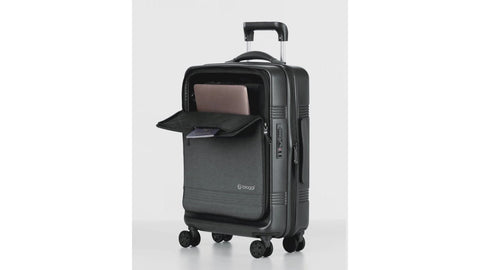
If you plan to check a foldable bag regularly, choose a model built for it. The Runway Large Check-In Suitcase uses a polycarbonate shell with a front-facing opening, an integrated TSA lock, and silent-run Hinomoto wheels, and it carries a 10 year warranty.

Watch out: folding a checked bag along the same crease every trip weakens that line faster than any other part of the bag.
How to Choose Luggage for Frequent Travel Without Overpaying
Choosing luggage for frequent travel means paying for the parts that fail, not the features that photograph well.
Skip the marketing. Focus on what you can touch.
A Five-Point Check You Can Do in the Store
A few checks can help before you buy:
- Wheels: Spin all four. They should glide silently and wobble-free.
- Handle: Extend and retract the telescoping handle five times. It should lock firmly at each stop.
- Zippers: Run each zipper the full length. No snagging, no skipped teeth.
- Seams: Check double stitching at handle mounts and corners.
- Fold: Fold and unfold the bag twice. It should return to shape without sagging.
If any point fails, walk away. A bag that wobbles in the store will wobble worse after a year of airport floors.
Wheels, Handles, and Zippers: The Parts That Actually Break
Wheels, handles, and zippers are often the first parts to wear. These are the moving parts, and moving parts wear out. On a foldable bag, they also interact with the fold mechanism, a wheel housing mounted near a crease takes more flex than one mounted on a rigid frame.
A Foldable-Specific Durability Checklist
Most buying guides tell you to spin the wheels and tug the handle. That is not enough for a bag that folds. Use this repeatable check before you buy:
- Seam strength at fold points: Pinch the fabric along the crease and pull gently. The seam should feel tight and reinforced, not loose or single-stitched. Double stitching or bar-tacks at the ends of the crease are a good sign.
- Fabric abrasion at the crease: Rub your thumb firmly along the fold line ten times. If the coating feels tacky, patchy, or starts to flake, it will not survive repeated folding.
- Zipper performance under flex: Open the bag, fold it halfway, and run the zipper through its full length while the bag is flexed. A zipper that snags only when the bag is folded will be a recurring problem.
- Wheel stability at the mount: Rock each wheel side to side. The housing should not flex independently of the bag body. Plastic housings that move separately from the frame crack first.
- Handle attachment under load: Extend the handle and press down on the bag as if it were fully packed. The handle mounts should not creak or shift. On foldable bags, handle mounts near a fold are a common weak point.
If any of these checks fails in the store, it will fail worse after a year of airport floors.
Why These Parts Fail on Foldable Bags
Wheel durability depends on the housing as much as the wheel itself.
Handle strength comes down to the telescoping tubes and the lock mechanism. A handle that flexes under load will eventually jam.
Zipper strength is about tooth size and pull quality. Coil zippers flex well on soft bags. Metal zippers resist bursting but can corrode.
For a frequent flyer, these parts decide whether a bag lasts two trips or two years. Everything else is secondary.
Load Limits, Packing Habits, and Storage That Add Years
Overloading a foldable bag is the fastest way to shorten its life. Every extra kilo strains seams, zippers, and the frame.
Pack to the bag's stated load capacity, not to the space you can force shut. If the zipper needs two hands and a knee, the bag is overloaded.
A few habits add years:
- Distribute weight low and toward the wheels
- Leave the expansion zipper closed unless you need it
- Empty and air the bag between trips
- Store it folded, dry, and away from damp
Storage matters more than most people think.
Maintenance is simple. Wipe the wheels, check the zipper pulls, and inspect seams twice a year. Small repairs now beat replacing the bag later.
Pick a Bag That Fits Your Closet and Your Calendar
The right foldable bag matches your storage space and your travel frequency. To weigh closet space against travel needs, read How Much Space Does Foldable Luggage Save?.
Weekly flyers need stronger frames, better wheels, and reinforced seams. Occasional travelers can prioritize storage savings. Minimalists want organization built in.
Biaggi offers foldable luggage designed for space-saving storage and everyday travel. Biaggi has been featured on Shark Tank.
A quick way to decide:
- Travel weekly: prioritize wheels, handle, and frame strength
- Travel monthly: balance storage savings with seam quality
- Travel a few times a year: storage savings and light weight matter most
Frequently Asked Questions
Are foldable suitcases durable enough for frequent travel?
It depends on the build, not the folding concept. A foldable suitcase used weekly needs reinforced seams, a coated fabric with abrasion resistance, and a tested folding frame. Durability also depends on travel frequency, airline handling, storage, material, and how heavily the bag is loaded, . Treat a cheap foldable as an occasional-trip bag and a well-built one as a regular companion.
How long do foldable suitcases typically last?
No published test gives a single lifespan figure for foldable suitcases, so judge by use. Occasional travelers may get several years from a light foldable, while weekly flyers should expect the folding joints and zippers to wear first. Check warranty coverage before buying: Biaggi's Runway check-in suitcase carries a 10-year warranty, which is a useful signal of how long the maker expects the shell and components to hold up.
Are foldable suitcases suitable for checked luggage?
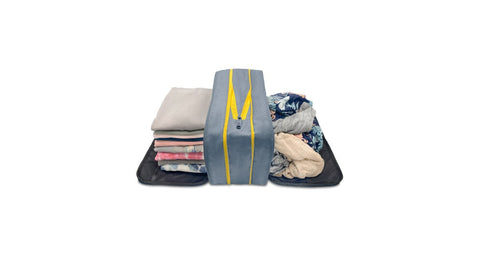
They can be, with caveats. Checked bags face rough baggage belts and drop impact, so a foldable checked bag needs a sturdy frame, protected wheels, and strong zippers. Foldable designs generally trade space savings against rigid protection, which matters more in the hold than in the cabin. For checked trips, pair a foldable with packing cubes and avoid overloading it beyond its stated capacity.
What materials make a foldable suitcase more durable?
Look for coated fabric with good abrasion resistance, reinforced stress points at seams and handle mounts, and metal rather than plastic hardware at the joints. Zipper strength and wheel durability matter as much as the shell. On the hard side, a German polycarbonate shell paired with Japanese Hinomoto wheels, as on Biaggi's Runway carry-on, shows the component quality to compare against when you shop.
The real challenge is not finding a foldable bag. It is finding one that survives your calendar and still fits your closet. Biaggi builds foldable luggage with space-saving storage, lightweight construction, and travel-ready design, including the Runway Hardside Hybrid Carry On with Japanese silent-run Hinomoto wheels and a German polycarbonate shell. Get started with Biaggi and travel with a bag that works as hard as your schedule does.



Comments (0)
There are no comments for this article. Be the first one to leave a message!