
 Accounts
Table of Contents
- Expandable vs Non Expandable Carry-On Luggage: The Core Trade-Off
- How the Expansion Panel and Zipper Actually Work
- Quick Comparison: Expandable vs Non Expandable at a Glance
- Airline Carry-On Size Restrictions: Where Expanded Bags Fail
- Carry-On Weight Limits by Airline and the Expansion Penalty
- How to Pack a Carry-On for a Week Without Overpacking
- Real-World Packed Measurements: What Actually Fits
- Durability, Zipper Strength, and Long-Term Repair
- Which Should You Choose? A Decision Framework by Trip Type
- Frequently Asked Questions
Last Updated: October 9, 2026
Expandable vs Non Expandable Carry-On Luggage: The Core Trade-Off
An expandable carry-on is a suitcase with a zippered panel that adds roughly two inches of depth when unzipped, trading airline compliance for packing room. That single design choice, expandable vs non expandable carry-on luggage, decides whether you squeeze in one more sweater or pay a gate-check fee at the boarding door. At Biaggi, we build foldable luggage for people who pack tight and store tighter, so we watch this trade-off closely.

The extra depth sounds harmless until you measure it. Standard carry-on dimensions for major airlines sit at 22" x 14" x 9", per the MOACC travel community, and expansion typically pushes depth to 11 inches. That is the difference between a bag that slides into the overhead bin and one that gets tagged at the gate.
Below, we break down how expansion panels work, where they fail, and which trip types actually justify them.
How the Expansion Panel and Zipper Actually Work
An expansion panel is a second zipper running around the middle of the suitcase that releases a folded layer of fabric when opened. According to Travelpro's guide to expandable luggage, unzipping that panel typically increases suitcase depth by 2 inches. The mechanism is simple: the zipper holds compressed material flat until you need it.
Two things matter here. First, the expansion zipper is a separate component from the main closure, so it adds a second failure point over years of use. Second, the fabric panel and seams carry the load once expanded, which is why soft-sided luggage handles expansion better than hard-sided shells.
Quick Comparison: Expandable vs Non Expandable at a Glance
Non-expandable carry-ons stay within airline size limits by default, while expandable models offer flexible capacity at the risk of exceeding those limits. The table below summarizes the trade-offs.
| Factor | Expandable Carry-On | Non-Expandable Carry-On |
|---|---|---|
| Extra depth | Up to 2 inches | None |
| Airline compliance | Only when unexpanded | Always |
| Packing flexibility | High | Fixed |
| Weight | Slightly heavier | Lighter |
| Best for | Souvenirs, return trips | Strict size enforcement |
| Gate-check risk | Higher if expanded | Low |
The pattern is consistent: expansion buys packing flexibility and costs you certainty at the gate.
Airline Carry-On Size Restrictions: Where Expanded Bags Fail
Expanded bags fail at the sizer frame, not at check-in. Most airlines measure your bag at the gate, and a fully expanded softside carry-on can exceed the 22" x 14" x 9" limit that major carriers enforce. But the real problem is that "major carriers" is not a single standard. The table below shows how common airline limits interact with a typical 2-inch expansion panel.
| Airline (example) | Published carry-on limit (linear) | Typical expanded depth | Fits sizer when expanded? |
|---|---|---|---|
| American Airlines | 22 x 14 x 9 in | 11 in | No |
| Delta Air Lines | 22 x 14 x 9 in | 11 in | No |
| United Airlines | 22 x 14 x 9 in | 11 in | No |
| Southwest Airlines | 24 x 16 x 10 in | 11 in | Often yes |
| Ryanair | 55 x 40 x 20 cm | 28 cm | No |
| easyJet | 56 x 45 x 25 cm | 28 cm | No |
Limits are for standard carry-on allowances and change periodically; always verify with your airline before flying.
The pattern is clear: on most legacy US carriers and European low-cost airlines, a 9-inch depth limit means an expanded bag will not fit the sizer. Southwest's 10-inch depth gives a little more room, but even there, a fully packed expandable bag can bulge past 10 inches at the seams. SmarterTravel's carry-on rules explainer advises travelers with expandable bags to pack them unexpanded, warning that the added space may not be worth a gate-check fee. Enforcement varies by carrier and by gate agent, which makes expanded bags a gamble rather than a reliable strategy.
A more reliable approach is to treat expansion as a return-trip tool, not a departure tool. Fly out unexpanded and compliant; expand only after you have cleared security and are heading home, when a gate-check fee is less likely to derail your trip. If you routinely fly strict carriers, a non-expandable bag removes the guesswork entirely.
Carry-On Weight Limits by Airline and the Expansion Penalty
Weight limits catch more travelers than size limits on international routes. According to the Rick Steves Travel Forum discussion on carry-on weights, international carry-on weight limits can be as restrictive as 8 kg (about 17.6 lbs). That is a hard ceiling, and expansion does not help you meet it.
Expandable bags also tend to weigh more empty. A YouTube comparison of 2026 carry-on models, Best Carry On Luggage for 2026, weighed an expandable variant at approximately 2.1 kg, and some expandable bags run up to 12 lbs. Add the extra fabric, zipper, and panel, and you lose payload before you pack a single item.
The math is unforgiving. A lighter non-expandable shell leaves more room for actual contents under a strict weight cap.
How to Pack a Carry-On for a Week Without Overpacking
Packing for a week in a carry-on comes down to compression and cube discipline, not bag size. Here is the routine we recommend:
- Roll soft garments and place them in packing cubes
- Use compression cubes for bulky items like sweaters
- Wear your heaviest shoes and jacket on travel days
- Pack toiletries in containers under 100ml
- Keep one cube empty for souvenirs on the return trip
- Weigh the packed bag before leaving home
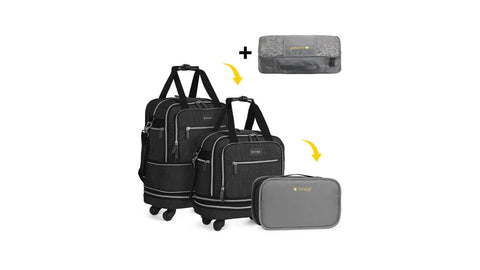
If you travel with a foldable bag like the Zipsak Boost! Underseater, which expands a full 5" upward, you start as an underseater and grow into a full TSA-approved carry-on only when you need it. That is a different kind of flexibility than a mid-body expansion panel, because the bag changes category rather than just gaining depth.

Real-World Packed Measurements: What Actually Fits
Real-world measurements beat spec sheets every time. A bag listed at 22" x 14" x 9" rarely measures that once packed, because soft sides bulge and hard shells do not. Expansion makes this worse: the panel adds depth, but overpacking can push the bag beyond even its expanded spec. A bag rated at 11 inches expanded can easily measure 12 or 13 inches at the seams if you stuff it.
Here is how to measure a packed, expanded carry-on correctly:
- Pack the bag as you would for the trip, including the items you plan to add on the return leg.
- Expand the panel fully and close all zippers.
- Measure height from the bottom of the wheels to the top of the extended handle. If the handle retracts into the bag, measure to the top of the bag body.
- Measure width at the widest point, which is often across the middle where the expansion panel sits.
- Measure depth at the deepest point, usually at the base or where the bag bulges most.
- Add the three dimensions to get linear inches, then compare against your airline's limit.
A common mistake is measuring an empty bag. An empty bag always fits; a full one is what the gate agent sees. Another mistake is measuring only the body and forgetting wheels and handles, which can add 1-2 inches to height. For a hybrid option, the Runway Hybrid Expandable Underseater fits under the seat and avoids the overhead-bin scramble entirely, which sidesteps the measurement problem for short trips.

If you want to avoid measuring altogether, choose a non-expandable carry-on that meets your airline's limit with room to spare. If you need expansion for souvenirs, pack it unexpanded on the outbound leg and measure before you board the return flight. That way, you get the flexibility without the gate-check risk.
Durability, Zipper Strength, and Long-Term Repair
Zipper strength and seam quality determine how long an expansion panel lasts. The expansion zipper takes repeated stress every time you overpack and unzip, and a failed zipper on a soft-sided bag is difficult to repair without a luggage specialist.
Hard-sided luggage avoids the fabric-panel problem but loses the flexibility. A hybrid design, like the Runway Hardside Hybrid Carry On, combines a German polycarbonate shell with soft-side packability, using Japanese Hinomoto wheels for smooth rolling. For travelers who want the durability of a hard shell without giving up access, that middle ground is worth considering.
The MyESCPlan side-by-side luggage analysis found that expansion features add convenience but introduce durability trade-offs, especially for frequent flyers who pack and unpack weekly.
Which Should You Choose? A Decision Framework by Trip Type
Choose expandable if your trips mix business and leisure and you shop on the return leg. Choose non-expandable if you fly strict carriers, travel internationally with weight caps, or want a bag that never fails the sizer.
Here is how we would decide:
- Weekend trips, domestic: Expandable or foldable, packed unexpanded
- Week-long business travel: Non-expandable or hybrid, lighter and compliant
- International travel with weight limits: Non-expandable, to save every pound
- Souvenir-heavy return trips: Expandable, but measure before boarding
- Urban apartment storage: Foldable, like the Glide Expandable Carry On at 5.95 lbs, which stores flat between trips
The Glide's front-opening design also means you pack once and reach in without flipping the bag flat, which matters in tight hotel rooms and small apartments alike.
The real challenge is not picking a side in the expandable vs non expandable carry-on luggage debate; it is finding luggage that adapts to how you actually travel. Biaggi builds foldable, space-saving carry-ons designed to fit in your closet and handle both weekend getaways and business trips. Our signature Zipsak folds into a pouch and expands into a full carry-on, and our Glide and Runway models pair lightweight shells with smart access. Get started with Biaggi and travel with luggage that works as hard as you do.
Frequently Asked Questions
Is it worth getting an expandable suitcase?
It depends on how you travel. An expandable carry-on adds roughly 2 inches of depth when unzipped (Travelpro, 2026), which helps on return trips with souvenirs. But if you fly often on strict airlines, the extra space can push you over the standard 22 x 14 x 9 inch limit and trigger a gate-check fee (SmarterTravel, 2026). Buy expandable if you want flexibility; buy fixed if you want a bag that always fits.
Can you travel with an expanded carry-on?
You can board with it, but only if the expanded bag still meets your airline's carry-on size restrictions. Most US carriers cap standard carry-ons at 22 x 14 x 9 inches, and a fully expanded bag often exceeds that depth. SmarterTravel advises packing expandable bags in their non-expanded configuration so they stay compliant, then unzipping after you land.
What are the downsides of expandable carry-on luggage?
Three main ones. First, expansion can push a bag past cabin dimensions and force a gate check. Second, expandable bags can weigh more, with some reaching 12 lbs (RedFlagDeals Forum, 2026). Third, clamshell designs limit how efficiently you can pack. A hybrid like the Biaggi Runway Hardside Hybrid Carry On ($199.99) balances structure and packability without those compromises.
How does expandable luggage affect carry-on weight limits?
Expansion adds volume, not weight allowance. International carriers can cap cabin bags at 8 kg (about 17.6 lbs) (Rick Steves Travel Forum, 2026). Fill an expanded bag and you may hit that limit before you run out of space. Weigh your packed bag at home, and check carry-on weight limits by airline before you fly, since they vary widely.
Do airlines have different size limits for expandable bags?
No airline publishes a separate limit for expandable bags. Enforcement is based on the bag's measured dimensions at the gate, expanded or not. That means an unzipped bag that exceeds 22 x 14 x 9 inches gets treated like any oversized carry-on. Pack it unexpanded for boarding, and you avoid the problem entirely.


Comments (0)
There are no comments for this article. Be the first one to leave a message!