
 Accounts
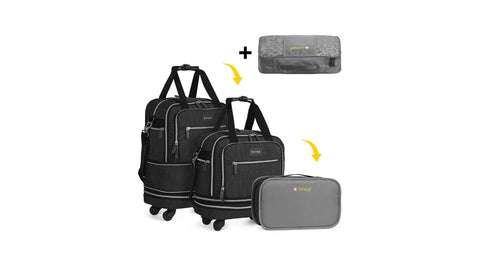
Table of Contents
- Why Foldable Luggage Works for Both Weekend and Long Trips
- Best Foldable Travel Bags by Trip Type
- Foldable Carry-On Luggage: Fitting Airline Sizers and Overhead Bins
- Foldable Luggage for Long Trips: Capacity, Load and Wear
- Foldable Luggage vs. Traditional Suitcase: What You Trade
- Packing and Storing Foldable Luggage in Small Apartments
- Conclusion
- Frequently Asked Questions
Last Updated: October 21, 2026
Why Foldable Luggage Works for Both Weekend and Long Trips
A foldable travel bag does the job of two or three bags while collapsing into a fraction of the space when empty. At Biaggi, we designed our foldable luggage around that tension, because most travelers do not want a closet full of hard-shell cases they use twice a year.
The travel-bag market is projected to grow from USD 35.97 billion in 2026 to USD 349.19 billion by 2034, according to Fortune Business Insights' travel bag market forecast, which signals how much demand exists for bags that adapt rather than multiply.
Here is the part most guides get wrong. Foldable luggage is not one product category. A weekend underseater and an expandable check-in bag solve different problems, and buying the wrong one is why people end up owning three bags instead of one.
Best Foldable Travel Bags by Trip Type
The best foldable travel bags split into two jobs: short trips where you never want to check a bag, and longer trips where capacity matters more than compactness.
Weekend-Ready Picks: Underseaters and Compact Duffels
For a two-to-three-night trip, an underseater that slides beneath the airplane seat is the most efficient choice.
Our Zipsak Boost! Underseater starts as a small, easy-to-store pouch and opens into a four-wheeled carry-on that fits under the seat in front of you.

For travelers who want the cubes sorted from day one, the Zipsak Boost Underseater Bundle at $129.99 adds Ultimate Compression Cubes and the Mini Cubes Duo at a 20% saving.
Long-Trip Picks: Expandable Check-In Capacity
Longer trips need a bag that grows with the itinerary. The Zipsak Boost-Max + Zipcube Set begins as a storable pouch, rolls out as a five-wheeled carry-on, then expands 11 inches upward into a large check-in bag. The custom Zipcubes add structure and spread weight evenly, and the tear-proof, water-resistant nylon handles repeated folding. It costs $119.99.
| Bag | Price | Starts As | Expands To | Best For |
|---|---|---|---|---|
| Zipsak Boost! Underseater | $99.99 | Storage pouch | Underseat to full carry-on | Weekend trips |
| Zipsak Boost Underseater Bundle | $129.99 | Storage pouch | Underseat to full carry-on | Weekend trips with cubes |
| Zipsak Boost-Max + Zipcube Set | $119.99 | Storage pouch | Carry-on to check-in | Long trips |
| Runway Hybrid Expandable Underseater | $164.99 | Structured underseater | Underseat carry-on | Business travel |
Foldable Carry-On Luggage: Fitting Airline Sizers and Overhead Bins
Foldable carry-on luggage works on major airlines because the bag is built to the sizer, not around it.
Two details decide whether a foldable carry-on actually flies as a carry-on. First, check packed dimensions against your airline's published sizer before you buy, since limits vary by carrier.
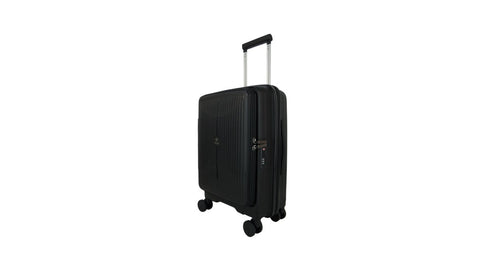
Our Runway Hybrid Expandable Underseater, at $164.99, addresses this with a structured build, easy front access, and a hidden drink port.
Foldable Luggage for Long Trips: Capacity, Load and Wear
Foldable luggage for long trips succeeds or fails on two things: how much it actually carries when expanded, and whether the fabric and hardware survive repeated folding. Judge a bag by its packed dimensions and weight distribution when full, not by the liter number on the listing.
What Different Capacities Actually Hold
Most travelers overestimate what a long-trip bag needs because they count outfits instead of loads. A useful rule of thumb:
- 30-35 L (weekend underseater): 2-3 days of clothing, one pair of shoes, a toiletry kit, a 13-inch laptop, and a charger pouch. This is the realistic ceiling for a bag that must slide under the seat.
- 40-45 L (full carry-on): 4-6 days if you pack cubes and wear your bulkiest layer on travel day. Add a second pair of shoes only if you sacrifice a jacket.
- 55-70 L (expanded check-in): 1-2 weeks of mixed clothing, or a week of cold-weather layers. This is where a foldable bag stops behaving like a carry-on and starts behaving like checked luggage.
Before you trust any capacity claim, pack the bag with the load you actually plan to carry, then measure the packed exterior at its widest points, including bulges at the corners and base.
How Load Changes Performance
A foldable bag behaves differently at 10 lb than at 30 lb. Three things change as you add weight:
- Balance. A bag packed top-heavy tips forward on its wheels. Put shoes and dense items at the base, near the wheel housing, and soft clothing above.
- Structure. Unstructured nylon sags at the base once loaded, which shortens the effective wheel clearance and makes the bag drag. Packing cubes are not an accessory here, they are load-bearing. The Zipcubes in our Boost-Max set exist for that reason: they hold the bag's shape and keep weight even across the base.
- Handle and wheel strain. A telescoping handle feels fine empty and flexes under a full load. Check that the handle locks firmly at full extension and that the wheels sit close to the bag's corners, where the load is supported rather than cantilevered.
Weigh the packed bag before a long trip.
What to Inspect for Long-Term Wear
Durability in a foldable bag concentrates at a few points. Inspect these before you buy, and again once a season:
- Fold lines. The crease is where coated nylon fatigues first. Look for a reinforced or double-stitched fold rather than a single seam.
- Zippers. A long-trip bag needs a coil or molded-tooth zipper sized for the load, with a pull that stays attached under tension.
- Seams at the handle and wheel housing. These take the full loaded weight. Look for bar-tacking or box-and-cross stitching rather than a single line of stitching.
Our Zipsak bags use tear-proof, water-resistant nylon, and the fold lines are the first place to inspect on any collapsible bag, since that is where wear concentrates.
Foldable Luggage vs. Traditional Suitcase: What You Trade
Foldable luggage trades a small amount of rigidity for a large amount of storage flexibility, and that trade is worth it for most urban travelers.
If you routinely travel with fragile equipment, pack it in a structured cube inside the foldable bag.
| Factor | Foldable Luggage | Traditional Suitcase |
|---|---|---|
| Empty storage | Folds to pouch or shelf size | Occupies full footprint |
| Structure | Relies on cubes for shape | Rigid shell holds shape |
| Flexibility | Expands for extra capacity | Fixed capacity |
| Protection | Good with packing cubes | Better for fragile items |
| Best for | Small apartments, varied trips | Frequent fragile cargo |
The storage difference is significant: a hard-shell carry-on takes up closet floor space year-round, while a folded Zipsak takes up roughly the space of a shoebox.
Packing and Storing Foldable Luggage in Small Apartments
Storing foldable luggage in a small apartment comes down to one habit: fold it the moment you unpack, not the night before the next trip. A bag left open on the floor never gets collapsed.
How to Fold the Bag Without Damaging It
A repeatable fold sequence keeps the crease in the engineered fold line instead of creating new ones:
- Empty and air the bag. Unpack fully, including the packing cubes, and let the bag sit open for a few hours so any moisture from the trip evaporates.
- Collapse the handle first. Retract the telescoping handle completely before folding; folding around an extended handle stresses the housing.
- Work from the base up. Fold the wheel end toward the center along the existing crease, then fold the top panel over. Follow the seams the manufacturer built in rather than forcing a new fold line.
- Leave a little slack. Do not compress the bag flat against itself. A small gap at the fold keeps the coating from cracking under tension.
- Secure the pouch. Use the built-in strap or compression band rather than stuffing the bag into a tight sack, which creases the fabric unevenly.
How to Pack It for a Trip
Packing order affects how the bag rolls and how much it holds:
- Base layer: shoes, dense toiletries, and anything heavy, placed near the wheel end to keep the center of gravity low.
- Middle layer: packing cubes of folded clothing, packed vertically so you can see and pull one cube without unpacking the rest.
- Top layer: soft items, a jacket, and anything you need at the gate.
For a weekend underseater, leave roughly a fifth of the bag empty on the outbound leg for purchases or laundry on the return. For a long trip, pack cubes first, then fill the gaps around them.
How to Store It Between Trips
A workable routine for a tight space:
- Unpack and air the bag the same day you return
- Fold along the existing creases, not new ones
- Store the pouch on a closet shelf or under the bed, away from direct sunlight and damp
For travelers weighing one bag against two, our Zipsak Boost-Max covers both a weekend and a two-week trip by expanding from carry-on to check-in, which means one stored pouch instead of a closet of cases.

Conclusion
The hardest part of buying foldable luggage is not finding a bag, it is resisting the urge to buy three. Match one expandable piece to how you actually travel, and the storage problem solves itself.
Biaggi builds foldable luggage for exactly this: bags that start as a storable pouch, roll out as a carry-on, and expand when the trip gets longer. Underseater at $99.99, the Boost-Max + Zipcube Set at $119.99, and the Runway Hybrid Expandable Underseater at $164.99, each designed to fold down and fit in your closet between trips.

Get started with Biaggi and travel with one bag that adapts to the trip instead of a closet full that do not.
Frequently Asked Questions
What size suitcase is best for a weekend trip?
For two to three nights, most travelers need 30 to 40 litres of packing space, which is roughly the capacity of an underseat bag or a small carry-on. A foldable underseater that expands upward gives you that weekend capacity without taking up closet space at home. If you pack layers or shoes, aim for the top of that range. Anything above 45 litres is usually more bag than a weekend requires and pushes you toward overhead-bin or checked-bag rules.
Can foldable luggage be used as a carry-on?
Yes, provided the packed dimensions stay within your airline's limits. Some foldable designs are built specifically as underseaters that slide under the seat in front of you, and some of those expand upward into a full-size carry-on when you need more room. Check the packed dimensions rather than the folded size, since the bag grows once it is loaded. Measure the filled bag before your first flight and confirm it against your carrier's published sizer.
Is foldable luggage durable enough for long trips?
Durability depends on the fabric and the frame, not on whether the bag folds. Look for tear-proof, water-resistant nylon and a structure that holds its shape when loaded, such as custom-sized packing cubes that add rigidity and spread weight evenly. Repeated folding stresses seams and zips, so check stitching and wheel housings before buying. A well-made foldable bag handles regular trips, but treat the fold points as the first place to inspect for wear.
How big of a luggage do I need for a 2 week trip?
Two weeks usually lands between 60 and 90 litres depending on laundry access and climate. If you can wash clothes midway, a large carry-on that expands into check-in capacity covers it. An expandable foldable bag that grows from carry-on size to a larger check-in bag gives you both options in one piece, so you can travel carry-on for the flight out and check the bag on the return when souvenirs add weight.
How do you choose foldable luggage for different trip lengths?
Match capacity to nights, then check folded size against your storage. Weekend trips need roughly 30 to 40 litres, one-week trips 40 to 60, and two weeks or more 60 to 90. After capacity, compare packed dimensions against airline sizers, weight when empty, and how small the bag folds down. A bag that expands across two size classes often replaces two separate suitcases, which matters most if you live somewhere with limited closet space.
Will a foldable bag protect clothes and electronics from getting crushed?
A soft foldable bag offers less rigid protection than a hard-shell case, so pack accordingly. Structured packing cubes give the bag shape and keep contents from shifting, and they create a buffer around fragile items. Put electronics in a padded sleeve near the centre of the bag rather than against an outer wall, and avoid stacking heavy items on top of the bag in a car boot. For flights, the bag travels in the overhead bin or under the seat, where compression is limited.


Comments (0)
There are no comments for this article. Be the first one to leave a message!