
 Accounts
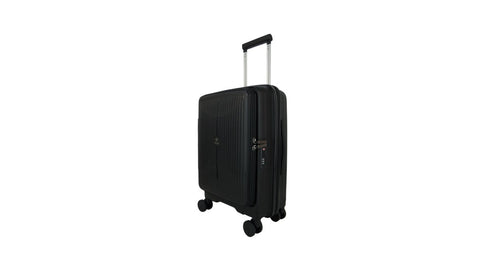
Table of Contents
- Why Business Travelers Are Rethinking the Carry-On
- Underseat Bag vs Carry-On Suitcase: The Trade-Offs That Matter
- Underseat Luggage Size for Airlines: What Fits Where
- The Business Travel Backpack With Laptop Compartment
- Foldable Luggage for Business Trips: Storage That Disappears
- Five Carry-On Alternatives Compared: Pricing, Pros, and Cons
- How to Choose: A Practical Decision Framework
- Frequently Asked Questions
Last Updated: October 19, 2026
Why Business Travelers Are Rethinking the Carry-On
The standard wheeled carry-on is not the only option anymore. Frequent flyers are switching to carry-on luggage alternatives for business travel, underseat bags, garment backpacks, and foldable luggage that collapses into a closet shelf, because the traditional hard-shell case solves a problem many short business trips do not have.
At Biaggi, we build foldable luggage for exactly this shift. The logic is simple: if your trip is two nights and one meeting, you do not need 40 litres of rigid shell. You need something that holds a blazer, a laptop, and a charger, then disappears when you get home.
Here is what most guides get wrong. They compare carry-on luggage alternatives as if capacity were the only metric. In practice, business travelers weigh four things: overhead bin risk, garment condition on arrival, laptop access at security, and where the bag lives between trips.
That last one matters more than people admit. A carry-on that eats half a closet floor in a small apartment is a daily cost, not a one-time purchase.
Underseat Bag vs Carry-On Suitcase: The Trade-Offs That Matter
An underseat bag wins on speed and gate-check risk; a carry-on suitcase wins on volume and rolling comfort. Choose the underseat bag for one to three night trips where you board late and cannot afford to lose your bag at the gate.

The trade-offs break down predictably:
- Boarding position. Underseat bags skip the overhead bin scramble entirely. No gate-check surprise on a full flight.
- Capacity. A carry-on suitcase holds more. If you pack shoes, gym kit, and a suit, the suitcase still wins.
- Mobility. Rolling luggage is easier over long terminal walks. A backpack or shoulder bag frees both hands but loads one shoulder.
- Access in flight. An underseat bag stays with you. Your laptop and documents never leave your sight.
- Storage at home. This is where most comparisons stop, and where foldable designs change the maths.
The honest limitation: underseat bags force discipline. You cannot overpack your way out of a tight connection.
Underseat Luggage Size for Airlines: What Fits Where
Underseat space is smaller and less standardized than overhead bin space, so measure before you buy. Most major airlines publish personal-item limits in the region of 40 x 30 x 15 cm, but the space under the seat in front of you varies by aircraft, seat position, and whether a media box is installed.
What the published limits do not tell you is that the usable underseat cavity is rarely a clean rectangle. On many narrow-body aircraft, the space is shallower at the front where the seat frame drops, and a media box or power outlet can eat 5-8 cm of depth on one side. A bag that measures exactly to the airline limit can still fail to slide in on the wrong seat.
A practical way to test before you fly:
- Measure the cavity, not the bag. At home, use a tape measure to mark your bag's true exterior dimensions including wheels and handles, then compare against your airline's personal-item limit. Add 1-2 cm of clearance for fabric bulge.
- Check the seat map, not just the airline. Aisle seats often have less underseat clearance than middle or window seats on the same aircraft because the seat leg and aisle-side frame intrude. Bulkhead rows usually have no underseat storage at all.
- Prefer soft-sided and hybrid bags for tight fits. A soft-sided bag compresses into irregular cavities; a rigid bag does not. If your route mixes aircraft types, a soft or hybrid underseater is the lower-risk choice.
- Test the bag loaded, not empty. A bag that slides under the seat when empty can jam once packed, because the base panel bows outward under load.
A common pattern among frequent business travelers is to keep a small tape measure in the front pocket of their underseat bag for the first few trips on a new route, then stop once they know which aircraft and seat types they usually get. The FAA passenger baggage guidance is a useful starting point for what carriers must allow, but seat-level dimensions come from the airline itself. Confirm with your carrier's own carry-on page before every new route, not once a year.
The Business Travel Backpack With Laptop Compartment
A business travel backpack with a dedicated laptop compartment is the fastest option through security and the most work-ready bag in the terminal. The padded sleeve keeps the device protected, and a front pocket keeps chargers, cables, and passports reachable without unpacking.
What separates a good business backpack from a generic one:
- A suspended laptop sleeve that keeps the base of the device off the bag floor, so a dropped bag does not transfer impact straight to the chassis.
- A front pocket sized for a passport and boarding pass, so you are not digging at the gate.
- Compression straps that stop the load shifting when the bag is half empty.
- Water resistance on the base panel, which is where airport floors and wet tarmac do their damage.
The drawback nobody mentions: backpacks wrinkle suits. If you are carrying a jacket, a garment-focused bag beats a laptop backpack every time.
Foldable Luggage for Business Trips: Storage That Disappears
Foldable luggage for business trips solves the problem the other alternatives ignore: where the bag lives when you are not traveling. A foldable case compresses into a small pouch that fits on a closet shelf, which matters if you live in a compact apartment or a dorm room.
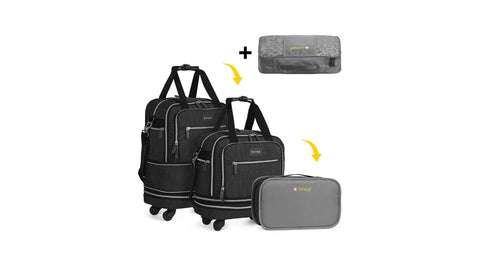
This is the category we know best. Our Zipsak Boost! Underseater starts as a small, easy-to-store pouch, opens into a four-wheeled bag that slides under the seat, and then expands a full 5 inches upward into a full-size TSA-approved carry-on. One bag covers a two-night trip and a five-night trip.
The honest caveat: folding mechanisms add moving parts. Look for reinforced hinges and a shell that holds its shape when open, or the bag will sag once it is loaded.

Five Carry-On Alternatives Compared: Pricing, Pros, and Cons
Five carry-on luggage alternatives for business travel cover nearly every trip scenario, ranging from a foldable underseater that stores in a pouch to a hybrid hard-shell carry-on.
| Option | Price | Best For | Key Trade-Off |
|---|---|---|---|
| Zipsak Boost! Underseater | $99.99 | One-bag trips, tiny storage | Folding mechanism needs care |
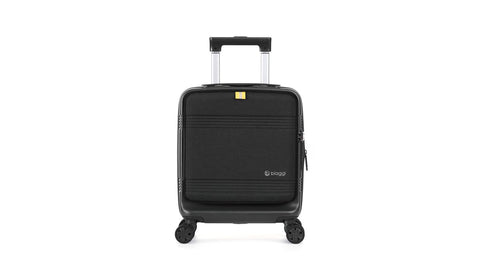
| Glide Expandable Carry On | $119.99 | Front-access packing | Hardside, not foldable |
| Runway Hybrid Expandable Underseater | $164.99 | Gate-check avoidance | Less capacity than a carry-on |
| Runway Hardside Hybrid Carry On | $199.99 | Frequent flyers, durability | Larger footprint at home |
| Runway Carry On + Zipcubes Bundle | $219.99 | Organized packers | Highest upfront cost |
Zipsak Boost! Underseater, $99.99. Our pick for the smallest storage footprint and the widest trip range. It packs into a pouch, rolls under the seat, and expands into a full carry-on.

Glide Expandable Carry On, $119.99. At just 5.95 lbs with a polypropylene shell, this is the lightest option here. The front-opening design means you pack once and reach in without flipping the case flat.
Runway Hybrid Expandable Underseater, $164.99. Built for travelers who keep getting burned by gate checks. It fits under the seat, has easy front access and a hidden drink port. The drawback is capacity: it holds less than a full carry-on.
Runway Hardside Hybrid Carry On, $199.99. German polycarbonate shell and Japanese silent-run Hinomoto wheels make this the durability pick for weekly flyers. It is not foldable, so it claims closet space year-round.
Runway Carry On + Zipcubes Bundle, $219.99. The Runway case plus a 3-pack of carry-on Zipcubes and the Mini Cubes Duo, which fit the case like a jigsaw. Best for people who pack by category. It costs the most upfront.
How to Choose: A Practical Decision Framework
Most guides tell you to 'choose by trip length,' which is true but not useful enough. Business travelers face a narrower set of recurring scenarios, and each one points to a different bag.
Scenario 1: The one-to-two-night city trip with a single meeting. You need a laptop, a charger, one change of clothes, and a jacket that arrives presentable.
Scenario 2: The three-to-four-night trip with a suit or formal wear. Capacity and wrinkle prevention both matter.
Scenario 3: The multi-city trip with trains, taxis, and stairs. Wheeled luggage loses its advantage on cobblestones, train platforms, and stairwells. A backpack or a hybrid underseater that converts to a shoulder carry is faster and less fatiguing.
Scenario 4: The weekly flyer with a fixed routine. Durability and repairability outweigh storage. A hard-shell carry-on with replaceable wheels and a solid warranty is the long-term value pick, even if it claims closet space year-round.
Scenario 5: The occasional traveler in a small apartment. Storage is the deciding factor. A foldable bag that compresses into a pouch gets used more because it is not in the way between trips.
Once you have matched your scenario, run these checks in order:
- Count your typical nights away. One to three nights, go underseat or foldable. Four or more, you need full carry-on capacity.
- List what must arrive unwrinkled. A blazer or dress shirt pushes you toward a garment-focused design or packing cubes, not a duffel.
- Check your laptop size against the sleeve. Measure the device, not the nominal screen size, and confirm the sleeve is suspended off the bag floor.
- Measure your closet shelf. If storage is tight, foldable is not a nice-to-have, it is the deciding factor.
- Set a total cost ceiling. One well-chosen bag beats two cheap ones you replace. Factor in packing cubes, which do more for organization than an extra pocket ever will.
On total cost and long-term value: a foldable bag that stores out of sight tends to get used more, and a bag you actually use is the only kind that pays for itself.
Frequently Asked Questions
Does a backpack count as an underseat bag?
Yes, if it fits within the airline's underseat dimensions. Most carriers allow a personal item roughly 40 x 30 x 15 cm, though these limits vary. A business travel backpack with a laptop compartment works as an underseat bag on most flights, but check your specific airline before boarding. If the backpack is too large or overstuffed, gate staff may ask you to check it, which defeats the purpose of traveling light.
What is the typical size of an underseat cabin bag?
Most airlines set underseat luggage size for airlines at around 40 x 30 x 15 cm (16 x 12 x 6 inches), but the range is wide. Some allow 45 x 36 x 20 cm, while stricter carriers cap personal items smaller. Always measure the bag's packed dimensions, not its empty size, because a full bag bulges. A soft-sided underseat bag or a foldable design that expands upward gives you more flexibility than a rigid frame.
Can an underseat bag hold a laptop and work clothes?
A well-organized underseat bag can hold a 13- to 15-inch laptop, a charger, a folder, and one change of clothes for an overnight trip. Use packing cubes to compress garments and keep the laptop in a padded sleeve. For trips longer than two nights, an underseat bag vs carry-on suitcase comparison usually favors the carry-on for clothing capacity. Pair an underseat bag with a foldable carry-on if you need both work gear and several days of outfits.
How do I choose an underseat bag for a business trip?
Start with your airline's personal-item limit, then match the bag's packed dimensions to it. Prioritize a padded laptop compartment, easy front access, and a luggage pass-through if you also bring a rolling bag. Consider total cost and long-term value: a foldable or expandable design that stores flat in a small apartment may justify a higher price than a cheap duffel that wears out. Try the bag packed before your first trip to confirm it slides under the seat.


Comments (0)
There are no comments for this article. Be the first one to leave a message!